We've finally had a solar storm! Ooooooh! Data! Plots! Explanations!
It started yesterday and continued today, as seen in the Space Weather Prediction Center's real-time Kp index. Kp is a single number that characterizes magnetospheric activity through ground based measurements of the Earth's magnetic field. It ranges from 0 to 9, 0 being nothing; 9 being doomsday. 4 or 5 is what I would call "stormy" or "disturbed" conditions. We hit that yesterday and reached a Kp of 7 early this morning.
It should be pointed out that while Kp was high, the "Disturbance Storm Time", or Dst index, was not very high (more accurately, it wasn't very low.) Dst is a rough measure of the amount of energy being deposited into the magnetosphere; the lower the number, the more energy there will be. This storm racked up a Dst of -40; a good storm will hit -100 or more.
I started receiving electron flux warnings from SWPC yesterday afternoon. This is a warning that the radiation belt electron flux (or how many electrons pass through a certain area per second) surpassed 1000 cm^-3*str^-1*s^-1. These are "killer electrons", or electrons with enough energy to penetrate the outer shielding of spacecraft and cause electric charge buildup on internal circuits. While the 1000 mark is one of SWPC's warning levels, the exact "danger zone" for electron flux depends on each satellite and is rarely well known.
FYI- based on the plot quality and fonts used, SWPC is clearly using IDL to generate their output. They should switch to a more modern language *coughpythoncough*.
**EDIT** It was pointed out, rightfully so, that only a short time ago I was a die hard IDL fan. As such, this comment is a bit hypocritical. Whoops.
Let's take a look at what could be driving this activity. The first key item to look at is Interplanetary Magnetic Field (IMF, or the Sun's magnetic field that is locked in the solar wind and carried to Earth). Specifically, the Z-component or "Bz". When IMF Bz is negative, the IMF can couple to the Earth's magnetic field to deliver energy to the magnetosphere system. The coupling method is called magnetic reconnection; I'll get to this later... eventually. The other things to notice are a jump in both solar wind density and Earthward velocity. Both increases cause the magnetospheric system to be driven harder, which we saw in the electron flux and in the Kp index. I'll need to see more data to figure out what kind of solar storm this is, but right now I'd guess that this is a high-speed-stream event.
I'll follow up on this storm and let you know if anything really fun happens with it.
Showing posts with label space weather. Show all posts
Showing posts with label space weather. Show all posts
Monday, April 5, 2010


Tuesday, November 10, 2009
Numba Two!
Well, actually number 9, but the second frame in a slide show.
Tom's Hardware (they're hiring, by the way...) has a list of the top 10 threats to the internet; solar storms come in at number 9.
It's nice to be acknowledged.
Tom's Hardware (they're hiring, by the way...) has a list of the top 10 threats to the internet; solar storms come in at number 9.
It's nice to be acknowledged.
Sunday, October 18, 2009
Space Weather on TV
Well, kinda...
While listening to the Detroit Lions get destroyed by Green Bay and simultaneously watching the Giants get beat up on by the Saints on TV, I saw a commercial for the Air Force. The situation on this commercial is as follows: on a space station orbiting Earth, the crew has witnessed a piece of space junk ricochet off another piece and hurl straight towards *gasp* the space station itself! The team quickly makes the proper adjustments, and everyone is safe. The Air Force logo flies onto the screen with text letting you know that this isn't the future, it's NOW! Holy smokes!
I've talked about space junk before. It's a huge problem and there are many groups whose sole purpose is to track every single piece. However, if something was to suddenly change direction, it's unlikely that you'd be able to move out of the way in time AND in a safe manner. So, the commercial was a bit of an exaggeration.
The Air Force, however, has a great space weather program. They are currently working on internalizing as many numerical models as quickly as possible to create a powerful forecasting system. They have good scientists that bring cutting edge work to conferences on a consistent basis. A commercial that would have been more accurate and just as compelling could have been one about the imminent danger posed by a solar flare (or other solar event.) It would have better represented their capabilities and near-future goals.
Ugh, the Lions are terrible on defense.
While listening to the Detroit Lions get destroyed by Green Bay and simultaneously watching the Giants get beat up on by the Saints on TV, I saw a commercial for the Air Force. The situation on this commercial is as follows: on a space station orbiting Earth, the crew has witnessed a piece of space junk ricochet off another piece and hurl straight towards *gasp* the space station itself! The team quickly makes the proper adjustments, and everyone is safe. The Air Force logo flies onto the screen with text letting you know that this isn't the future, it's NOW! Holy smokes!
I've talked about space junk before. It's a huge problem and there are many groups whose sole purpose is to track every single piece. However, if something was to suddenly change direction, it's unlikely that you'd be able to move out of the way in time AND in a safe manner. So, the commercial was a bit of an exaggeration.
The Air Force, however, has a great space weather program. They are currently working on internalizing as many numerical models as quickly as possible to create a powerful forecasting system. They have good scientists that bring cutting edge work to conferences on a consistent basis. A commercial that would have been more accurate and just as compelling could have been one about the imminent danger posed by a solar flare (or other solar event.) It would have better represented their capabilities and near-future goals.
Ugh, the Lions are terrible on defense.
Wednesday, September 23, 2009
Two Groups!
Wow! Looking at the sun today, you can see two scoops groups of raisins sunspots!
Check out the SOHO MDI image:

Check out the SOHO MDI image:
Space weather, here we come!
Tuesday, September 1, 2009
Achievement Unlocked: 3rd Most Boring Solar Cycle
Today is September 1st. Time to look at the sunspot number over the past month!
The last time this happened? June, 1913. 1913!!!
Solar Cycle 23 has now secured the bronze for the longest solar cycle in recorded history at 150 months. Gold and silver go to cycles 4 and 6 with 164 and 153 months, respectively. What is the perspective of a space science blogger on these matters?

*Sunspot numbers were zero using the international sunspot number. Provisional numbers from NOAA SWPC show a sudden jump to 10 sunspots on the 31st.
The last time this happened? June, 1913. 1913!!!
Solar Cycle 23 has now secured the bronze for the longest solar cycle in recorded history at 150 months. Gold and silver go to cycles 4 and 6 with 164 and 153 months, respectively. What is the perspective of a space science blogger on these matters?

*Sunspot numbers were zero using the international sunspot number. Provisional numbers from NOAA SWPC show a sudden jump to 10 sunspots on the 31st.
Wednesday, June 24, 2009
GEM Update
The GEM workshop rolls on; here's an update from the world of space environment modeling.
GEM is very busy; there are several sessions, or "break-out sessions", occurring at one time. Because of the concentration of the material, you're always missing something that is both interesting and relevant to your research. The meeting is supposed to be in "workshop mode", which means talks are short and discussion is long. There is typically a 50% compliance rate with this.
Probably the most interesting information coming out of the workshop so far is how separate space weather models handle the same events. While there are some large-scale similarities, there are many important differences. These differences come up in the three major MHD models in the community - or, in plain-speak, three numerical models, relying on the same underlying physics, all give different results for the same solar driving conditions.
This is a somewhat scary revelation, though not at all surprising. In essence, it means that what we think we know, what the model is actually doing, and what we think the model is doing can all be conflated together and not consistently with each other. Much of this comes with the differences in the way the physics are implemented in the different codes and the different parameters you can change within a single code.
The solution is a lot of work: model parameter space mapping, data-model comparisons, and comparisons to other models. Within a single modeling group, this is a fine solution, but sharing and comparing such results is not always a welcome proposition. As funding can depend on model performance, teams are often reluctant to share these verification and validation results to the world even though it is a necessary step towards better science.
Such was the case this week: modelers could not settle on a set of community-wide verification/validation methods and metrics. This is, of course, a case of history repeating. Some groups do understand the importance of these comparisons and are making concessions and contributing, but others are clamming up as hard as they can.
GEM is very busy; there are several sessions, or "break-out sessions", occurring at one time. Because of the concentration of the material, you're always missing something that is both interesting and relevant to your research. The meeting is supposed to be in "workshop mode", which means talks are short and discussion is long. There is typically a 50% compliance rate with this.
Probably the most interesting information coming out of the workshop so far is how separate space weather models handle the same events. While there are some large-scale similarities, there are many important differences. These differences come up in the three major MHD models in the community - or, in plain-speak, three numerical models, relying on the same underlying physics, all give different results for the same solar driving conditions.
This is a somewhat scary revelation, though not at all surprising. In essence, it means that what we think we know, what the model is actually doing, and what we think the model is doing can all be conflated together and not consistently with each other. Much of this comes with the differences in the way the physics are implemented in the different codes and the different parameters you can change within a single code.
The solution is a lot of work: model parameter space mapping, data-model comparisons, and comparisons to other models. Within a single modeling group, this is a fine solution, but sharing and comparing such results is not always a welcome proposition. As funding can depend on model performance, teams are often reluctant to share these verification and validation results to the world even though it is a necessary step towards better science.
Such was the case this week: modelers could not settle on a set of community-wide verification/validation methods and metrics. This is, of course, a case of history repeating. Some groups do understand the importance of these comparisons and are making concessions and contributing, but others are clamming up as hard as they can.
Thursday, June 4, 2009
Spring AGU Wrap-up
Spring/summer is always rough because of the number of conferences that take place. This year I have three week-long trips within five weeks, each requiring a good amount of preparation on my behalf. Before I take off for my second trip, here's the highlights from the AGU Joint Meeting (aka spring AGU) as far as space science:
I did enjoy Canada, however. Where else can you leave your wallet in an airport (yes, I did) and have it returned with every penny and every piece of plastic in place and unmolested (yes, that too)?
- There was a good portion of presentations dedicated to the TWINS satellites, which are now pumping out data. These satellites carry instruments that detect high energy neutral atoms flying away from the magnetosphere, yielding interesting data products -- including temperature maps of the magnetosphere. While this is a data source I'm not familiar with, it could be a very powerful method for exploring magnetospheric dynamics.
- The space weather sections were mildly interesting. They served more as a show-and-tell session rather than a true science expo. Right now, there are three agencies working to convert science computer models to operational computer models: NASA's Community Coordinated Modeling Center (CCMC), NOAA's Space Weather Prediction Center (SWPC), and the Air Force Research Laboratory (AFRL). How these entities will coexist has yet to be determined.
- There was a crazy guy there. See upcoming post.
I did enjoy Canada, however. Where else can you leave your wallet in an airport (yes, I did) and have it returned with every penny and every piece of plastic in place and unmolested (yes, that too)?
Tuesday, May 26, 2009
Space Weather Webcast at the AGU Conference
Log in NOW to view the session "Space Weather Prediction: Are We There Yet?" Sessions on this topic will be occurring today AND tomorrow!
CLICK HERE.
CLICK HERE.
Tuesday, May 12, 2009
Space Crap: There's a lot of it.
Old news: Back in February of this year, an American satellite from the Iridium constellation collided with a Russian satellite from the Cosmos constellation (both in Low Earth Orbit, or "LEO"). This highlights one of the issues with near-Earth outer space: it's crowded as all get-out. One of the difficulties of flying spacecraft, both manned and unmanned, is ensuring it is not going to run into something else. As more and more satellites are put into orbit, this sort of event becomes increasingly difficult to avoid.
Newer news: the result of this collision? A bunch of space debris was released, creating an even more hazardous environment. You can read more about this at spaceweather.com, third story down as of today (no hard links on their site!) To give you an idea of how much space junk was placed into orbit by this crash, here's a great picture from the site (click to embiggen):

Newer news: the result of this collision? A bunch of space debris was released, creating an even more hazardous environment. You can read more about this at spaceweather.com, third story down as of today (no hard links on their site!) To give you an idea of how much space junk was placed into orbit by this crash, here's a great picture from the site (click to embiggen):
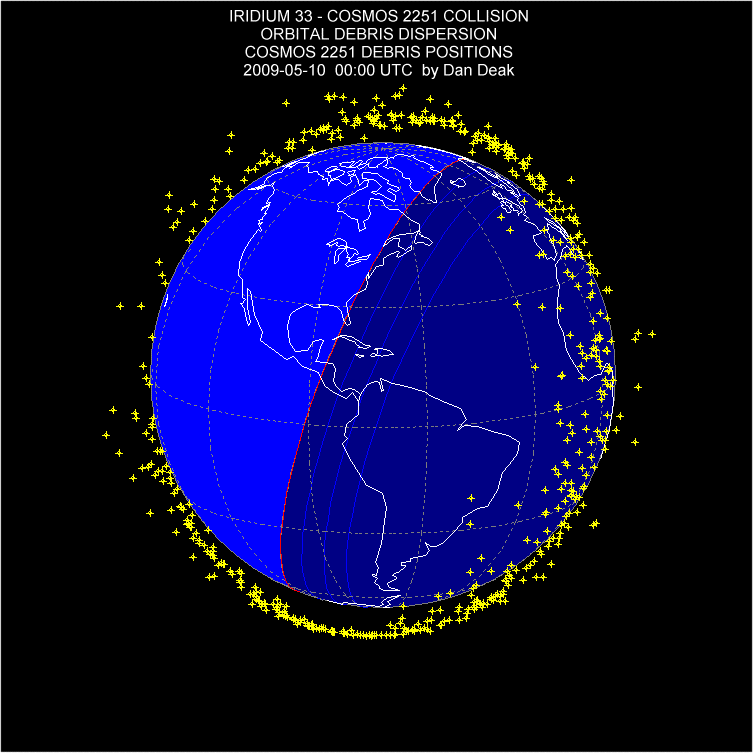
All of those objects are from this single event. This is only a small percentage of the total space garbage present around Earth, whose sources range from dead satellites, satellite debris, debris from rockets and manned space flights, to naturally occurring objects such as micrometeorites. This poses two huge problems: one, where is this stuff? There are companies that do nothing but track space garbage in the sky and sell this information to space agencies. Two, where can we put a satellite without hitting this stuff, or, alternatively, is a particular satellite safe from collisions with this space trash?
While I focus on solar driven space weather on this blog, space debris is a vital part of space weather as well. Constantly tracking the innumerable bits of garbage is one more factor that goes into avoiding the hazards of near-Earth outer space.
While I focus on solar driven space weather on this blog, space debris is a vital part of space weather as well. Constantly tracking the innumerable bits of garbage is one more factor that goes into avoiding the hazards of near-Earth outer space.
Wednesday, May 6, 2009
Solar Activity, Ahoy!
Last week I posted concerning a sunspot on the western near-equatorial region of the sun. What I should have focused on is the new sunspot on the eastern limb as detected by the STEREO B satellite. This spot is currently hidden from Earth (the STEREO mission has two satellites that see the sides of the sun that can't bee seen from Earth) but will rotate into view in the next few days.
Yesterday, this region produced a Coronal Mass Ejection (CME), a violent release of mass, radiation, and magnetic field into the solar system. While this particular CME had no chance of hitting the Earth, these are the kind of events that damage satellites, over load electrical grids, put our astronauts in danger and produce the beautiful aurora. The sun is, apparently, slowly waking from its long cycle minimum.
A movie of the CME event can be found here.
Be sure to check out the latest images from the STEREO Mission!


Yesterday, this region produced a Coronal Mass Ejection (CME), a violent release of mass, radiation, and magnetic field into the solar system. While this particular CME had no chance of hitting the Earth, these are the kind of events that damage satellites, over load electrical grids, put our astronauts in danger and produce the beautiful aurora. The sun is, apparently, slowly waking from its long cycle minimum.
A movie of the CME event can be found here.
Be sure to check out the latest images from the STEREO Mission!
Thursday, April 30, 2009
Space Weather Workshop
Right now, the Space Weather Workshop, hosted by NOAA's Space Weather Prediction Center, is being held. This is the first time since 2006 that I have missed this meeting, which is a bit disappointing because it is very enjoyable. Today is the forecasting day when various agencies deliver updates on forecasting capabilities to NOAA, the Airforce and Navy, and each other.
You can see the types of information delivered at this conference by perusing last year's talks, available here.
To get an idea of the government's current space weather prediction capabilities, be sure to check out SWPC's website.
You can see the types of information delivered at this conference by perusing last year's talks, available here.
To get an idea of the government's current space weather prediction capabilities, be sure to check out SWPC's website.
Monday, April 27, 2009
A bit of activity!
Ladies and gentlemen, the sun is trying its hardest to not be boring. From the Stereo satellite mission comes these images:


Is that a sunspot peeking around the side (the bright, active spot on the right hand side of the right image)? We haven't seen those lately...
EDIT: Bah! I've lost the images. See newer posts.
Is that a sunspot peeking around the side (the bright, active spot on the right hand side of the right image)? We haven't seen those lately...
EDIT: Bah! I've lost the images. See newer posts.
Monday, April 20, 2009
Sweet Sensationalism! The sun is coming to KILL!
Step 1: Read this article.
Step 2: Roll eyes.
If one needs an explanation as to the level of credulity present in the world today, look no further than our news media. The key to this article is how they wrap some good facts and good science in pure and total sensationalistic garbage to scare up as many readers as possible (isn't that how they all work?)
Good: Discussion of the effects of space weather, mention of the Carrington Event, mention of the solar cycle, and recognition of Dan Baker's constant work to raise awareness, especially among our leaders, of the problems space weather can pose.
Bad: Saying that the next solar storm of Carrington-proportions will happen within three years during what will likely be the weakest solar cycle this century! I've already discussed how our current solar cycle is exceptionally unspectacular; I'll be expanding on this shortly. Let me emphasize, however, that as far as we currently understand, we are not "due" for anything except the next solar maximum.
As if complete ignorance of the solar conditions both now and in the near future isn't bad enough, the author completely negates his fear-inducing title in his own article.
Title:
Third-to-last line:
So, it may not come in three years - or even fourteen - but you DAMN WELL BETTER BE READY! And just to show you what the sun will look like on that fateful day:

In case you missed it, the caption of the picture is "Trouble ahead: How the sun storm might look in London." Dear readers, I assure you- if the sun ever looks like this, the last thing we will worry about is the electricity going out.
Step 2: Roll eyes.
If one needs an explanation as to the level of credulity present in the world today, look no further than our news media. The key to this article is how they wrap some good facts and good science in pure and total sensationalistic garbage to scare up as many readers as possible (isn't that how they all work?)
Good: Discussion of the effects of space weather, mention of the Carrington Event, mention of the solar cycle, and recognition of Dan Baker's constant work to raise awareness, especially among our leaders, of the problems space weather can pose.
Bad: Saying that the next solar storm of Carrington-proportions will happen within three years during what will likely be the weakest solar cycle this century! I've already discussed how our current solar cycle is exceptionally unspectacular; I'll be expanding on this shortly. Let me emphasize, however, that as far as we currently understand, we are not "due" for anything except the next solar maximum.
As if complete ignorance of the solar conditions both now and in the near future isn't bad enough, the author completely negates his fear-inducing title in his own article.
Title:
Meltdown! A solar superstorm could send us back into the dark ages - and one is due in just THREE years
Third-to-last line:
Of course, it may not happen in 2012 - it may not happen in 2023, the year of the next solar maximum.
So, it may not come in three years - or even fourteen - but you DAMN WELL BETTER BE READY! And just to show you what the sun will look like on that fateful day:
In case you missed it, the caption of the picture is "Trouble ahead: How the sun storm might look in London." Dear readers, I assure you- if the sun ever looks like this, the last thing we will worry about is the electricity going out.

Friday, April 3, 2009
Space weather affects us all - even the hooved ones.
A colleague and I were discussing Google street view (see previous post) and Google Earth today when he mentioned that using Google Earth, researchers have found that grazing animals, such as cows, tend to align themselves in a North-South direction. This would imply that these animals can sense the Earth's magnetic field. I responded that, in a possibly related story, one of the Google street view cars had hit a deer. Conclusion: get back to work.
Later, a good friend who now works at NASA called to let me know that he had run into a ground-breaking peer reviewed article. As it turns out, low frequency disturbances of the Earth's magnetic field (say, from power lines) effects the animals' orientation, breaking the typical poleward tendencies.
What can't science do?
I will now desperately try to make this relevant to this blog. During solar storms, there are strong deflections of the Earth's magnetic field, even on the surface. This leads to a plethora of effects: overloading of electric relay stations, intense heating of long oil pipelines, and... THE CONFUSION OF OUR CATTLE, WHO PREFER TO FACE NORTH-SOUTH.
Space weather affects us all. We must remain vigilant.
Later, a good friend who now works at NASA called to let me know that he had run into a ground-breaking peer reviewed article. As it turns out, low frequency disturbances of the Earth's magnetic field (say, from power lines) effects the animals' orientation, breaking the typical poleward tendencies.
What can't science do?
I will now desperately try to make this relevant to this blog. During solar storms, there are strong deflections of the Earth's magnetic field, even on the surface. This leads to a plethora of effects: overloading of electric relay stations, intense heating of long oil pipelines, and... THE CONFUSION OF OUR CATTLE, WHO PREFER TO FACE NORTH-SOUTH.
Space weather affects us all. We must remain vigilant.
Wednesday, April 1, 2009
Apparently I am a Psychic.
Minutes after posting about how little solar activity there is at the moment, I have found out that it's even calmer than I thought! We are currently in the fourth longest solar cycle in recorded history and will likely climb further up the list as the sun spot number (SSN) continues to fall. In March, we experienced 28 days without a sun spot (last year, March saw only 17 days without a blemish.) The averaged sunspot number values imply that we are likely to dip lower in the solar cycle, with fewer sunspots in April and possibly May.
Boring.
What are we missing out on? Check out this and this.
Solar min sucks.
Boring.
What are we missing out on? Check out this and this.
Solar min sucks.
All's quiet on the space weather front.
I may have made a critical mistake by instituting this blog during solar minimum. Space weather is boring right now. booorrrriiinnnggg.
The solar cycle is the 11 year period in the number of sunspots appearing on the surface of the sun. During maximum, the number of spots is at a peak and solar storms occur frequently. This leads to great videos of solar flares and coronal mass ejections, space weather storms at Earth, strong aurora, and bad impacts on technology (more on that in forthcoming posts.)
Right now, we're in solar minimum. What's happening in space? Jack crap, that's what. Just to give you an idea of how boring the sun is, examine the following:

This graph, from the Space Weather Prediction Center, is up-to-date as of the end of February. The blue/black lines are actual data; the red line is the sunspot forecast. As far as sunspots, we have bottomed out. This limits the amount of space weather news I can blog about -- especially exciting stuff.
As for the forecast, this is an extremely difficult prediction and rarely is accurate. In a few weeks, SWPC's annual Space Weather Workshop will commence and an updated prediction will be reported. While I won't be attending this year, I will blog on any important news that I hear from it.
The solar cycle is the 11 year period in the number of sunspots appearing on the surface of the sun. During maximum, the number of spots is at a peak and solar storms occur frequently. This leads to great videos of solar flares and coronal mass ejections, space weather storms at Earth, strong aurora, and bad impacts on technology (more on that in forthcoming posts.)
Right now, we're in solar minimum. What's happening in space? Jack crap, that's what. Just to give you an idea of how boring the sun is, examine the following:
This graph, from the Space Weather Prediction Center, is up-to-date as of the end of February. The blue/black lines are actual data; the red line is the sunspot forecast. As far as sunspots, we have bottomed out. This limits the amount of space weather news I can blog about -- especially exciting stuff.
As for the forecast, this is an extremely difficult prediction and rarely is accurate. In a few weeks, SWPC's annual Space Weather Workshop will commence and an updated prediction will be reported. While I won't be attending this year, I will blog on any important news that I hear from it.
Subscribe to:
Posts (Atom)